
The Science of Soil Resilience: A Homeowner’s Guide to the Houston Landscape

Most homeowners in the Houston area view lawn care as a series of chemical applications—nitrogen for greening, pre-emergents for weeds, and water for survival. However, viewing a lawn purely through the lens of “inputs” often leads to a cycle of diminishing returns. You may find that your yard requires more water every year just to stay green, or that the grass “craters” and thins out despite regular treatments.
To solve these issues, we have to look past the blades of grass and into the biological foundation of the property: the soil structure.
The Anatomy of Houston “Soil”
In Magnolia and the greater Houston area, we aren’t typically dealing with a balanced, nutrient-rich topsoil. Instead, most residential landscapes are built on a foundation of heavy, compacted clay and builder’s sand.The Compaction Crisis
Clay is composed of microscopic, plate-like particles that stack tightly together. When these particles are compacted—either from the construction process or years of foot traffic—there is virtually no “pore space” left for air or water to move. This creates two primary problems:- Low Infiltration: Water cannot penetrate the surface. Instead of soaking into the root zone, it reaches a saturation point almost immediately and begins to run off into the street.
- Anaerobic Conditions: Roots need oxygen to breathe. In compacted clay, the soil becomes anaerobic (oxygen-poor), which stunts root growth and favors the development of fungal pathogens.
The “Sugar Rush” Effect: Understanding Liquid Synthetics
It is common for homeowners to rely on 100% liquid fertilization programs. While these provide an immediate visual result, it is important to understand the chemistry behind them. Liquid synthetic fertilizers are essentially “salt-based” nutrients. Because they are already in a liquid state, the plant can absorb them almost instantly. This creates a “sugar rush” for the turf—rapid top-growth and a vibrant green color. However, because compacted clay has almost no organic matter to “hold” these nutrients, any nitrogen that isn’t immediately used by the plant is either washed away by rain or leaches deep into the ground where roots can’t reach it. This is why many lawns look fantastic for a week and then seem to “starve” shortly after. You are feeding the plant, but you are not feeding the soil.Building the “Organic Sponge”
To move away from the “sugar rush” cycle, the soil structure must be physically and biologically altered. The most effective way to do this is through a combination of Core Aeration and Compost Top Dressing.How Core Aeration Changes the Environment
Mechanical aeration pulls physical “plugs” out of the soil. This immediately relieves surface tension and creates deep channels. These channels are the “doorways” through which oxygen, water, and organic matter can reach the root zone.The Role of True Compost
When high-quality organic matter (true compost) is spread over an aerated lawn, it fills those channels and begins to act as a biological catalyst.- Water Retention: Organic matter can hold up to 10 times its weight in water. By incorporating this into the clay, you are transforming the soil from a “brick” into a “sponge.”
- Cation Exchange Capacity (CEC): In plain terms, organic matter acts like a magnet for nutrients. It “catches” the fertilizer you put down and holds it in the root zone so the plant can feed on it over a period of weeks rather than days.
The Biological Danger of “Nitrogen Robbery”
One of the most common mistakes in DIY soil improvement is using “compost” that hasn’t been fully broken down. Many products sold in bulk or at box stores are actually finely ground mulch or wood chips. Nitrogen Robbery occurs when un-composted wood is introduced to a lawn. The microbes in the soil are tasked with breaking that wood down. To do so, they require a significant amount of nitrogen. Instead of the nitrogen going to your grass, the microbes “steal” it from the soil to fuel the decomposition of the wood. This leaves your lawn yellow and nutrient-deficient, often for an entire growing season. True compost should be dark, earthy, and have no visible wood chunks. It should be “biologically active,” meaning the work of decomposition is already finished and it is ready to provide nutrients, not take them.Climate Resilience: The Root-to-Freeze Connection
Houston’s weather is characterized by extremes—prolonged heat followed by sudden, deep freezes. The resilience of a landscape during these events is directly tied to the depth of the root system.- Drought Resistance: In a “sponge-like” soil rich in organic matter, roots grow deep to follow the moisture. When the surface dries out in the 100-degree heat, these deep roots keep the plant hydrated.
- Freeze Survival: A lawn with deep roots and a healthy “crown” (the part of the plant at the soil surface) has a much higher survival rate during a freeze. Healthy soil acts as an insulator. Plants that have been “pushed” with too much synthetic nitrogen in the late fall often have tender, watery growth that is easily destroyed by ice. A lawn fed with slow-release organics has “hardier” cellular structures that can withstand the cold.
Final Technical Summary
A healthy Houston lawn is the result of a “Soil-First” philosophy. By focusing on breaking down compaction, avoiding the “sugar rush” of cheap synthetics, and building an organic foundation, you create a landscape that is naturally more resistant to pests, diseases, and weather extremes. When the soil works correctly, the grass takes care of itself.Recent Posts
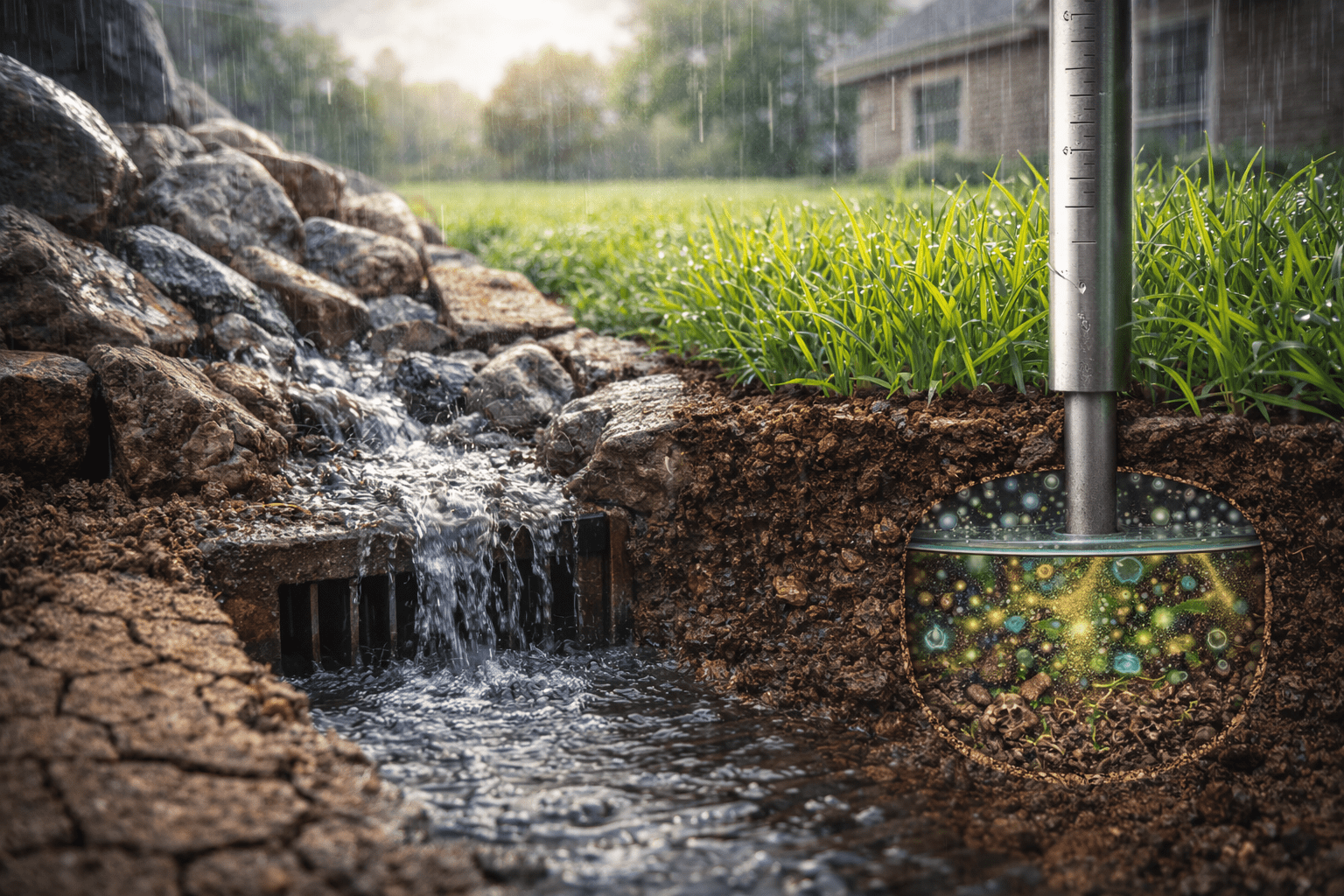
The Hydrological Landscape: Mastering Water Movement and Infiltration in Houston Soil
In the Houston and Magnolia regions, water is both a vital resource and a primary threat to landscape longevity. Between intense summer droughts and flash-flooding rainstorms, a property’s “hydrological design”—how…

The Immune System Landscape: Natural Defense Against Pests and Disease
For decades, the standard approach to landscape pests and diseases has been reactive: wait for a problem to appear, then apply a chemical to kill it. However, modern horticultural science…

The Houston Landscape Management Calendar: A Month-by-Month Technical Guide
In the Houston and Magnolia areas, our “growing season” is nearly year-round. This means the traditional rules of landscaping often don’t apply. Success in our climate isn’t about working harder;…